Is Pet Insurance Worth It? A Financial Analysis for Pet Owners

Content
Monthly pet insurance bills range from $30-$150, which adds up fast. You might pay $50 each month for years without filing a single claim—then your dog eats a sock and needs $3,200 emergency surgery. Was the insurance smart planning or wasted cash?
Most people never run these numbers until they're already at the emergency vet, trying to decide if they can afford the treatment their pet needs. That's exactly the wrong time to evaluate whether coverage makes sense.
Let's look at actual costs, real claim scenarios, and the specific factors that determine whether a policy will protect your wallet or just drain it. No marketing fluff—just the math and situations that matter.
How Pet Insurance Actually Works: Coverage Models and Payment Structures
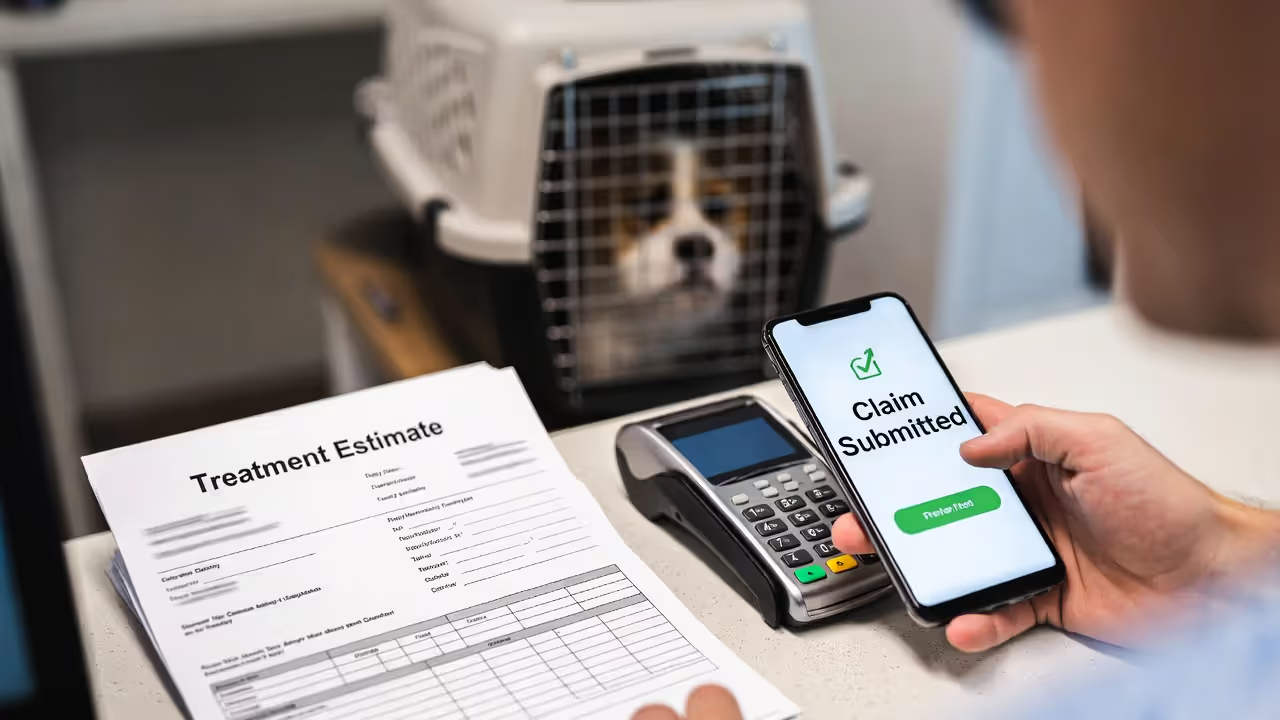
Unlike your health insurance, pet policies work on reimbursement. Your vet expects full payment when services are rendered. You submit receipts to your insurer afterward, and they send you money back based on your coverage terms.
Three numbers control what you actually get back. First, your annual deductible ($100-$500 typically) comes out of your pocket before the insurance company pays anything. Second, your reimbursement percentage—commonly 70%, 80%, or 90%—determines the insurer's share of costs above that deductible. Third, your annual or lifetime maximum sets a ceiling on total payouts, anywhere from $5,000 caps to unlimited coverage.

Author: Jordan Whitman;
Source: lamadone.net
Every policy includes waiting periods that block immediate claims. Break your dog's leg tomorrow? Most accident coverage starts in 2-3 days, so you're protected. Notice limping and get an illness diagnosis? That 14-day illness waiting period means you're paying out of pocket. Orthopedic problems like ACL tears often carry 6-12 month waiting periods, which prevents people from enrolling their already-limping dog and claiming the surgery next month.
Accident-only policies cost less—think $15-30 monthly—because they only cover injuries. Hit by a car? Covered. Snake bite? Covered. Lymphoma? Not covered. Comprehensive plans add illness coverage for infections, cancer, organ failure, and chronic diseases. They cost substantially more but actually protect against the expensive conditions that bankrupt pet owners.
Here's what trips people up: pre-existing conditions get zero coverage, and insurers interpret this broadly. Your puppy limped once at six months during a play session. You mentioned it to your vet, who noted it in the record but found nothing wrong. Two years later, your dog tears an ACL. The insurance company pulls those records, sees that previous limp notation, and denies your $4,500 claim. Anything documented before your coverage starts can become a coverage exclusion.

Author: Jordan Whitman;
Source: lamadone.net
Breaking Down the Real Costs: What You'll Pay vs. What You'll Get Back
Monthly premiums tell you almost nothing without context. That three-year-old Labrador mix costs maybe $35-50 monthly for solid comprehensive coverage. The same plan for a two-year-old French Bulldog? You're looking at $80-120 monthly because Frenchies rack up vet bills.
Cats generally run cheaper—$25-40 monthly buys comprehensive protection for most breeds. Location matters too. Insuring any pet in Los Angeles costs 30-40% more than in Columbus, Ohio.
Think long-term, though. Insure that dog from age one through twelve at $60 monthly average. That's $7,920 over the pet's life. But premiums don't stay flat—expect 5-10% annual increases as your pet ages. The $50 monthly premium you start with often doubles by age ten. Suddenly you're paying $100 monthly for a senior dog, which is $1,200 per year.

Author: Jordan Whitman;
Source: lamadone.net
Compare those costs against what you'd pay when things go wrong:
| Condition/Emergency | Average Cost Without Insurance | Typical Insurance Reimbursement (80% plan) | Out-of-Pocket With Insurance |
| Torn ACL/Cruciate Ligament | $3,500-$5,000 | $2,800-$4,000 | $700-$1,000 plus your deductible |
| Swallowed Object Surgery | $2,000-$4,000 | $1,600-$3,200 | $400-$800 plus your deductible |
| Cancer Treatment Course | $3,000-$8,000 | $2,400-$6,400 | $600-$1,600 plus your deductible |
| Diabetes (yearly management) | $2,500-$4,000 | $2,000-$3,200 | $500-$800 plus your deductible |
| Broken Leg Repair | $1,500-$3,500 | $1,200-$2,800 | $300-$700 plus your deductible |
| Bloat Emergency Surgery | $3,000-$6,000 | $2,400-$4,800 | $600-$1,200 plus your deductible |
One major emergency can equal three years of premiums. That foreign body surgery where your dog swallowed a corn cob? That's roughly 36 months of insurance payments for an average dog. But plenty of dogs live their entire lives without a single expensive emergency, meaning their owners paid thousands for coverage they barely used.
Where you live changes everything. Emergency vet care in San Francisco runs 50% more than in Oklahoma City. A procedure costing $2,000 in Tulsa might hit $3,500 in Manhattan. Insurance premiums reflect these regional cost differences, but they also cap your exposure to those inflated prices.
When Pet Insurance Pays Off: Scenarios Where Coverage Saves Money
Some situations turn insurance into an obvious financial win. Understanding these scenarios helps you predict whether your circumstances match the profiles where coverage delivers real value.
Emergency Surgeries and Accidents
Unexpected trauma creates the clearest insurance victories. Your dog bolts into the street and gets hit by a car. The emergency vet quotes $8,000 for surgery, three days hospitalization, and follow-up care. With 80% coverage after a $500 deductible, you're paying $2,100 instead of the full eight grand—even though you've only paid maybe $1,200 in premiums over two years.
Author: Jordan Whitman;
Source: lamadone.net
Young, reckless dogs generate these scenarios regularly. The eighteen-month-old Lab who swallows a corn cob needs $3,200 surgery. The ten-month-old puppy who jumps off the deck and breaks a leg requires $2,500 in orthopedic work. These accidents strike healthy pets without warning, and youth provides zero protection.
Multiple incidents over time really shift the math. One dog tore an ACL at three years old ($4,200), ate a sock requiring surgery at five ($2,800), then developed a mast cell tumor at seven ($3,500). Total vet bills exceeded $10,000 across four years. Insurance premiums during that period? Around $3,000. The policy reimbursed $8,000 of those expenses.
Chronic Conditions Diagnosed Early in Life
Early-onset chronic diseases create the strongest financial case for coverage. Imagine your three-year-old dog gets diagnosed with diabetes. Now you're looking at lifelong insulin, glucose monitoring supplies, and regular vet visits totaling $2,500-4,000 every single year. Over eight years, that's $20,000-32,000 in expenses. Insurance purchased before diagnosis covers these ongoing costs year after year.
Allergies hit dogs constantly. Severe environmental or food allergies mean specialized diets, daily medications, immunotherapy treatments, and dermatology visits adding up to $1,500-3,000 annually. Diagnosed at age two, your dog deals with this for life. Those claims quickly surpass every premium you'll ever pay.
Dr. Jennifer Coates, veterinary advisor and petMD contributor, explains:
Every month we see heartbreaking situations where owners face treatable conditions they simply cannot afford. Insurance provides more than financial value—it ensures pets actually receive necessary medical care rather than economic euthanasia or prolonged suffering because treatment costs exceed what the owner can access.
— Dr. Jennifer Coates
Epilepsy shows up in young dogs sometimes. So does inflammatory bowel disease. Autoimmune conditions can strike at two or three years old. When chronic problems appear early and insurance was already in place, the evaluating insurance pets value calculation swings heavily toward coverage. You're looking at a decade or more of claims that dwarf your premium payments.
Breed-Specific Health Issues
Certain breeds come with predictable health problems that insurance covers—but only if you buy early. Golden Retrievers develop cancer at frightening rates, around 60%. English Bulldogs routinely need soft palate surgery, hip replacements, and skin fold treatments. Dachshunds commonly require $4,000-6,000 IVDD surgery when their backs give out.
Buy insurance for a high-risk breed as a puppy, and you're covered when those breed-typical problems emerge. Take a Bernese Mountain Dog insured at $90 monthly. That's $1,080 per year. Over seven years, you've paid $7,560 in premiums. When the dog develops lymphoma at age seven requiring $6,000 in treatment, insurance covers $4,800. If other breed-related issues follow—and they often do—total lifetime claims might reach $15,000-20,000.
Timing determines everything with breed-specific issues. Insure that Bulldog puppy at eight weeks old, and the breed's notorious health problems fall under coverage. Adopt a four-year-old Bulldog already showing breathing problems? Those existing issues become pre-existing exclusions, and you're paying full premiums for partial protection.
When You're Better Off Self-Insuring: Situations Where Pet Insurance Falls Short
Pet insurance makes poor financial sense in several common situations. Sometimes building your own emergency fund beats paying premiums indefinitely.
Statistically healthy pets represent pure profit for insurance companies. Consider a ten-year-old mixed breed cat who's never had issues beyond annual checkups. That cat generated $3,000-4,000 in premiums over a decade with minimal claims filed. Putting that same money in a dedicated savings account would cover most emergencies while keeping the funds accessible.
Adopting senior pets creates terrible insurance economics. You adopt a seven-year-old dog, which means high premiums due to age, limited time before age-related conditions appear (possibly excluded as pre-existing), and fewer years to spread costs. A $100 monthly premium for that senior dog totals $1,200 yearly. Over five years, you've paid $6,000. Senior pets often develop multiple conditions simultaneously, hitting annual limits quickly or triggering exclusions.
Pre-existing conditions destroy insurance value for entire body systems. Adopt a dog with previous ACL surgery? Future orthopedic problems receive no coverage. Cat with prior urinary crystals? Future urinary issues won't be covered. You're paying full price for partial protection.
Some high-deductible plans with weak reimbursement rates actually cost more than paying out of pocket. Here's an example: $40 monthly premium, $1,000 deductible, 60% reimbursement. Sounds affordable initially. Your dog needs $3,000 surgery. You pay the $1,000 deductible plus 40% of the remaining $2,000 ($800), totaling $1,800 out-of-pocket. You've been paying monthly premiums and still face substantial costs.
Better alternative for some people: disciplined saving. Put $50-100 monthly into a separate account labeled "pet emergency fund." After three years at $75 monthly, you've accumulated $2,700—enough to handle many common emergencies. Six years gets you to $5,400. The crucial difference? That money stays yours whether you use it or not, unlike premiums that disappear forever.
Self-insurance works best for people with strong financial discipline, stable incomes, and the ability to absorb potential losses without devastation. It fails when emergencies strike early before savings accumulate, or when multiple expensive conditions occur in quick succession.
The Hidden Variables That Change the Equation
Several factors beyond simple premium costs determine whether insurance delivers value for your specific circumstances.
Geographic location creates massive variations. Emergency vet visits in Manhattan cost double what they run in rural Tennessee. Living where veterinary care runs 40% above national averages makes insurance more valuable because it caps your exposure to those inflated regional costs. Conversely, low-cost areas reduce the financial pain of paying directly.
Pet age at enrollment fundamentally reshapes the calculation. Enroll an eight-week-old puppy, and you're looking at decades of coverage with premiums starting low. Enroll a five-year-old dog, and you face higher initial premiums, fewer coverage years, and greater likelihood of developing conditions shortly after enrollment that might get scrutinized as pre-existing.
Breed predispositions require honest assessment. Mixed breed dogs generally carry fewer genetic health issues than purebreds. That mutt from the shelter faces lower health risks than a Cavalier King Charles Spaniel, whose breed experiences heart disease in over 50% of dogs by age five. Your pet's breed-related risks should directly drive your insurance decision.
Your personal risk tolerance and financial cushion matter more than people admit. Can you access $5,000 tomorrow for emergency surgery without devastating your finances? If yes, insurance functions as preference rather than necessity. If no, insurance provides crucial protection against financial catastrophe, even when pure mathematics don't favor it.
Some people genuinely sleep better knowing insurance covers emergencies, fully understanding they'll likely pay more in premiums than they'll receive in claims. That peace of mind carries value that spreadsheets miss. Others prefer controlling their money and accepting risk, even knowing one emergency could drain savings.
Evaluating insurance pets value honestly requires accounting for your specific psychology around money and risk. Financially conservative people who panic at unexpected expenses benefit from insurance beyond pure numbers. Risk-tolerant people with solid emergency funds might rationally skip coverage.
How to Calculate If Pet Insurance Makes Sense for Your Situation
Making an informed decision means working through specific questions about your circumstances rather than relying on general advice.
Start by calculating your actual cost exposure. Research common health issues for your pet's specific breed, age, and size. Young Labradors face ACL tears, foreign body surgeries, and hip dysplasia. Persian cats deal with kidney disease, dental problems, and respiratory issues. List probable conditions with associated costs so you understand potential expenses.
Estimate realistic lifetime premium costs with rate increases factored in. Get quotes for your specific pet, multiply by expected lifespan, then add 7% annually for inevitable rate hikes. That $50 monthly premium becomes $60 in year five and $70 in year eight. Over twelve years, actual total payments might hit $9,000-12,000.
Compare the break-even threshold. If premiums total $10,000 over your pet's lifetime, you need claims exceeding $10,000 to come out ahead financially. One major surgery plus one chronic condition often crosses this threshold. Zero major issues means you've paid $10,000 for minimal return.
Assess your emergency fund capacity realistically. Calculate how much you could access within 24 hours for emergency vet care without borrowing or devastating your finances. If that number exceeds $5,000, you can self-insure most scenarios. Below $2,000? Insurance provides important financial protection.
Consider your decision-making under pressure honestly. Would you decline a $4,000 surgery giving your pet 80% survival odds because you cannot afford it? If yes, insurance removes this impossible choice. If you'd find the money regardless of consequences, insurance becomes less critical.
Evaluate multiple quotes with different parameters. Compare accident-only versus comprehensive plans. Adjust deductibles from $100 to $500 and watch how premiums change. Model different reimbursement rates. Sometimes a 70% plan costs $20 less monthly than an 80% plan—over ten years, that's $2,400 in savings that might offset the lower reimbursement percentage.
Review policy exclusions with extreme care. Some insurers exclude certain breeds from specific coverage types. Others cap payouts for particular conditions below advertised maximums. Wellness riders covering routine care rarely provide actual value—you're essentially prepaying for predictable expenses with administrative overhead added on top.
Pet insurance cost benefit analysis ultimately requires projecting unknowable futures. Nobody can predict whether your specific pet will need expensive care. Insurance protects against worst-case scenarios while costing money in best-case scenarios. Your decision should reflect both financial mathematics and personal values around pet care.
FAQ: Common Questions About Pet Insurance Value
Making Your Decision With Clear Eyes
Pet insurance represents financial protection against unpredictable expenses, not a savings vehicle or guaranteed money-maker. The financial value pets insurance provides depends on unknowable factors—will your healthy puppy develop cancer at age five, or will she live to fourteen with nothing beyond routine care?
The strongest case for insurance involves young pets from high-risk breeds, owners with limited emergency funds, and people who want guaranteed access to expensive treatments regardless of cost. The case against involves healthy mixed breeds, owners with substantial savings, and people comfortable accepting financial risk.
Avoid the middle-ground mistake of buying inadequate coverage thinking you're protected. Accident-only plans or policies with $100 annual limits provide false security while still costing money monthly. If you choose insurance, buy comprehensive coverage with reasonable limits. If you choose self-insurance, commit to consistent saving and actually build a real emergency fund.
Whatever you decide, make the choice now—before you're facing a $4,000 vet bill with no plan. Research actual policies, read the full policy documents rather than marketing materials, and understand exactly what's covered and excluded. Or set up a separate savings account with automatic monthly transfers treating it like a non-negotiable bill. Either approach works. What doesn't work is hoping you'll never face expensive vet care and having no strategy when reality inevitably hits.