
Pet Insurance Cost — What You'll Pay Yearly for Dogs and Cats
Pet Insurance Cost — What You'll Pay Yearly for Dogs and Cats

Content
Here's what most pet owners don't realize when they start shopping for insurance: that "$35/month" advertised rate? It rarely tells the whole story.
You're probably budgeting for your dog or cat's coverage right now, trying to figure out if pet insurance fits your household finances. The real numbers are all over the map. I've seen policies ranging from $15 monthly for a young domestic shorthair cat in Arkansas to $215 monthly for an eight-year-old French Bulldog in Los Angeles—same coverage tier, wildly different prices.
Your actual spending depends on a mix of factors: breed quirks, where you live, your pet's birthday, and dozens of other variables insurance companies plug into their pricing algorithms. A mixed-breed puppy in Boise might run you $180 yearly, while insuring a senior Rottweiler in Brooklyn could hit $2,400 for similar protection.
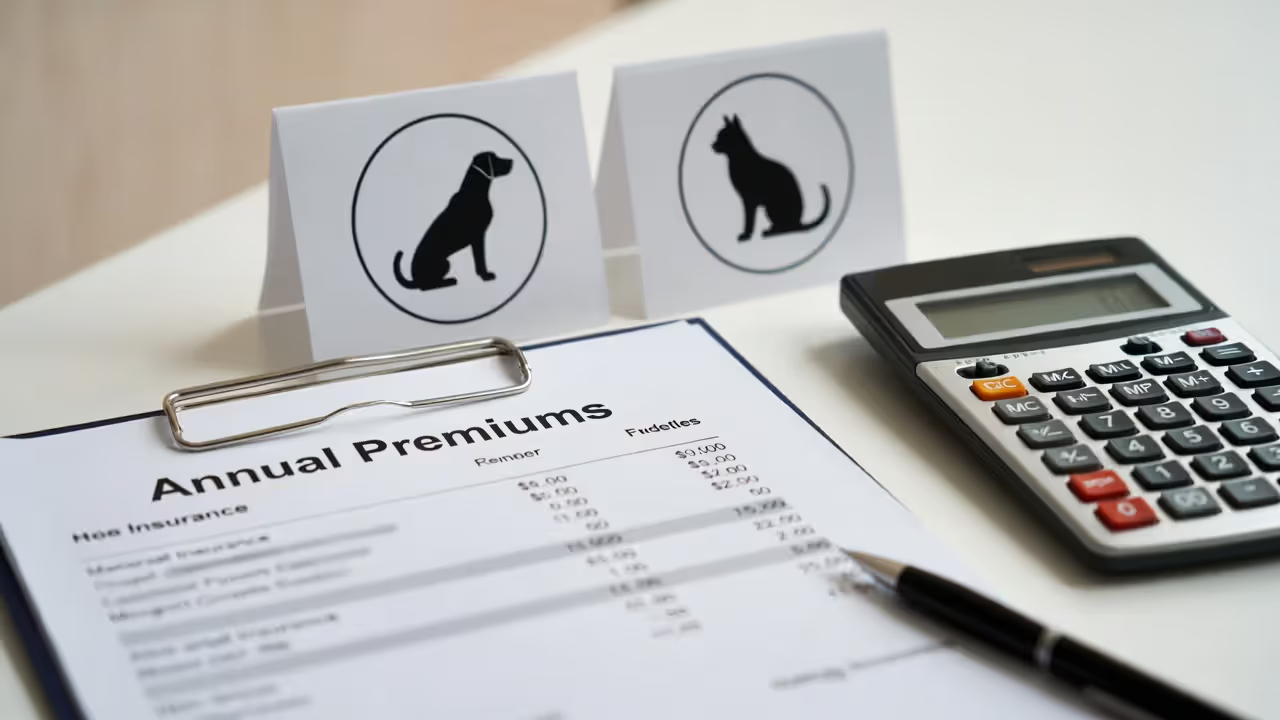
Average Annual Pet Insurance Premiums by Animal Type
Dogs drain your wallet faster than cats when it comes to insurance—typically 60-80% more expensive. Why? Veterinarians see dogs more often, and their treatments cost more. A dog's torn ACL surgery runs $3,500-5,000, while cats rarely face that particular problem.
Your pet's age matters just as much as species. That adorable puppy costs half what you'll pay once they hit their golden years.
| Pet Type & Age | Accident-Only (Annual) | Accident & Illness (Annual) | With Wellness Add-On (Annual) |
| Puppy (0-2 years) | $180-$300 | $450-$650 | $650-$900 |
| Adult Dog (3-7 years) | $220-$380 | $550-$850 | $800-$1,150 |
| Senior Dog (8+ years) | $280-$500 | $800-$1,500 | $1,100-$1,900 |
| Kitten (0-2 years) | $90-$150 | $250-$400 | $400-$600 |
| Adult Cat (3-7 years) | $110-$180 | $300-$500 | $500-$750 |
| Senior Cat (8+ years) | $140-$250 | $450-$750 | $700-$1,050 |
These numbers assume you've selected a $500 deductible, 80% reimbursement, and $10,000 annual cap. Your personal pet insurance annual cost might land higher or lower depending on your zip code and coverage choices.
Author: Ashley Reynolds;
Source: lamadone.net
Accident-only plans handle injuries—think car accidents, broken bones, or that time your dog ate a corn cob. No coverage for illnesses, though. That's why most people spring for accident-and-illness policies, which cover everything from diabetes to lymphoma. Wellness riders pay for routine stuff like vaccines and teeth cleaning, but here's the catch: you'll often spend more on the rider than you'd pay out-of-pocket for those predictable vet visits.
What Determines Your Pet Insurance Yearly Premium?
Eight major factors drive your yearly costs. Let's break down what actually moves the needle on your bill.
Breed-Specific Cost Differences
Got a purebred? Expect to pay 20-40% more than your neighbor with a mutt. Insurers know certain breeds come with expensive baggage. Great Danes develop heart problems. Bulldogs can't breathe properly. Dachshunds wreck their spines.
A Golden Retriever might cost you $720 per year, while a Newfoundland with identical coverage hits $1,050. Both are large, lovable breeds—but Newfies face higher cancer rates and shorter lifespans.

Author: Ashley Reynolds;
Source: lamadone.net
Cats show less breed-related price swings, though Persian, Ragdoll, and Maine Coon owners pay slightly more. These breeds carry genetic risks for kidney disease and heart conditions that mixed-breed cats typically dodge.
How Your Location Affects Annual Pricing
Your address matters more than you'd think. Veterinary costs in San Francisco run 40% higher than rural Alabama, and your insurance premium reflects that reality.
State regulations create another layer of complexity. California mandates certain consumer protections. New York restricts how dramatically insurers can raise rates. Meanwhile, Wyoming has minimal insurance regulation, which sometimes translates to lower premiums—but fewer guardrails if you have disputes.
Pet owners in major metros consistently pay more. That same coverage for your Labrador costs $850 in Chicago, $620 in Louisville, and $480 in Topeka. Geography isn't destiny, but it's a big piece of the puzzle.
Coverage Level and Deductible Impact
Here's where you can actually control your costs. Choose a $1,000 deductible over $250, and you'll slash $200-400 from your yearly pet insurance cost. Makes sense if you're mainly worried about catastrophic bills rather than $600 vet visits.

Author: Ashley Reynolds;
Source: lamadone.net
Annual limits create another trade-off point. Unlimited coverage sounds great—until you see it costs $400-600 more than a $10,000 cap. For context, only about 3% of claims exceed $10,000 in a single year. A $15,000-20,000 limit splits the difference nicely.
Reimbursement percentage affects your price less than most people expect. Jumping from 80% to 90% reimbursement usually adds just $50-120 annually. That's actually one of the better deals in policy customization.
Other pricing factors worth knowing:
When you enroll matters tremendously. Sign up before your pet turns two, and you've locked in lower baseline rates for life. Wait until age six, and you're starting from a higher price point that only climbs from there.
Claims history works differently than car insurance. Your individual claims won't trigger rate hikes. But if an insurer sees higher-than-expected claims across all customers, they'll raise everyone's rates the following year.
Multi-pet households get breaks. Most companies knock 5-10% off each additional pet you insure with them.
Payment timing affects cost. Pay annually instead of monthly, and you'll typically save 5% through an upfront payment discount.
Pet Insurance Cost Range: From Budget to Comprehensive Plans
The pet insurance market spans from bare-bones catastrophic coverage to Cadillac plans that cover acupuncture and behavioral therapy. Knowing what you get at each price tier prevents buyer's remorse.
Budget plans ($200-450 yearly for dogs, $150-300 for cats) feature high deductibles around $750-1,000, modest annual caps at $5,000-7,000, and 70% reimbursement. These work if you're specifically worried about worst-case scenarios—the $8,000 emergency surgery or $12,000 cancer treatment—but you'll still pay plenty out-of-pocket for medium-sized claims.
Mid-tier coverage ($500-900 for dogs, $350-600 for cats) hits the sweet spot for most households. You're looking at $500 deductibles, $10,000-15,000 annual caps, and 80% reimbursement. Covers both emergencies and significant illnesses without requiring a second mortgage.
Premium plans ($1,000-2,000+ for dogs, $700-1,200 for cats) bring low deductibles ($100-250), unlimited or very high annual caps ($25,000+), and 90% reimbursement. Some throw in wellness coverage, alternative treatments, even behavioral training. Worth considering if you've got a breed prone to chronic conditions or you simply want minimal surprise bills.
| Plan Tier | Monthly Cost | Annual Cost | Deductible | Annual Limit | Reimbursement | Best For |
| Budget | $20-$40 | $240-$480 | $750-$1,000 | $5,000 | 70% | Catastrophic protection only |
| Mid-Tier | $45-$75 | $540-$900 | $500 | $10,000-$15,000 | 80% | Balance of coverage and affordability |
| Premium | $85-$165 | $1,020-$1,980 | $100-$250 | Unlimited | 90% | Comprehensive protection, chronic conditions |
Biggest mistake I see? Choosing the cheapest option without thinking through the math. That $300 annual policy looks attractive until your $5,000 limit runs out in April, leaving you uninsured for eight months.
How to Lower Your Pet Insurance Annual Cost Without Sacrificing Coverage
Smart policy design can cut your pet insurance yearly premium by 30-50% while keeping meaningful protection intact.
Bump up your deductible strategically. Got $2,000-3,000 sitting in savings for emergencies? A $750 or $1,000 deductible makes total sense. You'll save $250-450 every year compared to a $250 deductible. Run the numbers: after two years of premium savings, you've already covered that higher deductible even if you need to use it.
Ditch wellness coverage. These add-ons cost $200-400 per year but typically reimburse only $150-300 in routine care. You're basically prepaying for predictable expenses with a service fee baked in. Stick that money in a savings account instead—you'll come out ahead.
Right-size your annual limit. Unlimited sounds appealing, sure. But only 2-3% of claims crack $15,000 in a single year. A $15,000 limit handles the vast majority of scenarios while costing hundreds less than unlimited plans.
Enroll early in your pet's life. A one-year-old dog might cost $480 annually. Wait until age four, and you're paying $650 for identical coverage—every single year for the rest of their life. Early enrollment also prevents pre-existing condition exclusions for problems that crop up as your pet ages.
Actually compare quotes from multiple providers. Sounds obvious, but premiums for identical coverage can vary 40% between companies. Spend an hour gathering quotes—you might save $300 every year.
Check if your employer offers pet insurance. Growing number of companies now include voluntary pet insurance in benefits packages, often with 10-15% discounts and convenient payroll deduction.
Investigate breed-specific insurers. A handful of providers specialize in particular breeds and sometimes offer better rates because they understand actual risk profiles rather than relying on broad industry generalizations.
Comparing Pet Insurance Providers: Annual Price vs. Value
Cheapest doesn't mean best. The lowest annual pet insurance price often comes with headaches—slow claims processing, aggressive denials, or coverage gaps you won't discover until you're standing in the emergency vet clinic.
When you're comparing providers, dig into:
Coverage exclusions and waiting periods. Some budget insurers exclude bilateral conditions—meaning if your dog develops hip dysplasia on the left side, the right hip isn't covered when it inevitably goes bad too. Others impose 14-day accident waiting periods versus the industry-standard 2-3 days.
Rate increase patterns. Every company raises rates as pets age, but some implement steeper jumps. Scan customer reviews for complaints about surprise 25-30% increases.
Claims satisfaction metrics. A provider that processes claims in five days and approves 95% of eligible claims delivers better value than one requiring extensive documentation and denying 30% of claims—even if the latter costs $100 less per year.
Veterinary network restrictions. Most insurers let you visit any licensed vet, but double-check before buying. Restricted networks limit your options during midnight emergencies.
I've watched too many pet owners chase the absolute lowest price, only to discover their budget policy excludes coverage for the exact condition their breed commonly develops—hip dysplasia in Shepherds, luxating patellas in Yorkies. A mid-tier plan from a reputable company with strong claims-paying history delivers better long-term value than hunting for rock-bottom prices. You're buying financial protection and peace of mind, not just checking a box.
— Dr. Jennifer Martinez, DVM, veterinary consultant with 18 years of clinical experience
Best approach: shortlist three to four providers with strong customer reviews and claims ratings, then compare prices for identical coverage specs. Now you're making apples-to-apples comparisons instead of guessing why one quote is mysteriously cheaper.
Is the Yearly Pet Insurance Cost Worth It? Real Cost-Benefit Analysis
Whether insurance makes sense depends on your financial cushion, risk tolerance, and gut feeling about your pet's health trajectory.
Let's run some realistic numbers. Average dog owners spend $500-800 yearly on routine vet care—wellness exams, vaccines, heartworm prevention. Pet insurance doesn't typically change this baseline spending. You're still paying for predictable stuff.
Where insurance proves its value: unexpected bombs. Foreign object surgery runs $3,500-7,000. Cancer treatment hits $5,000-15,000. ACL repair costs $3,000-5,000. One major incident can exceed your lifetime premium payments.
Break-even scenario with real numbers: You pay $600 annually for coverage with a $500 deductible and 80% reimbursement. Year three, your dog tears their ACL requiring $4,000 surgery. Insurance reimburses $2,800 (80% of the $3,500 after your deductible). Your total spend: $1,800 in premiums over three years, plus $1,200 out-of-pocket for this surgery, equals $3,000 total. Without insurance, you're paying the full $4,000. You've saved $1,000, plus you had coverage for years one and two if something else had happened.

Author: Ashley Reynolds;
Source: lamadone.net
The calculation flips if you can comfortably write a $5,000-10,000 check without breaking a sweat. Self-insuring—saving what you'd pay in premiums—works for financially secure people with iron discipline. Problem is, most households struggle to accumulate $8,000-12,000 in dedicated pet savings, making insurance a practical way to transfer risk.
Pet insurance makes most sense for:
- Owners of breeds prone to expensive conditions (Bulldogs, Great Danes, German Shepherds)
- Households that couldn't easily absorb a $3,000-5,000 surprise bill
- People who want medical decisions driven by what's best for their pet, not what their bank account allows
- Anyone who values predictable monthly budgets over potential long-term savings
It's less compelling when:
- You've got substantial emergency savings dedicated to pet care
- Your pet's already dealing with multiple pre-existing conditions that won't be covered
- You're looking at very senior pets (though this depends heavily on when you first enrolled)
- You're prepared to make end-of-life decisions based on quality-of-life rather than pursuing expensive treatments
Frequently Asked Questions About Pet Insurance Pricing
Pet insurance isn't a simple yes-or-no decision—it's a calculated financial choice based on your specific circumstances. The annual cost swings wildly depending on your pet's characteristics and your coverage preferences, but understanding what drives pricing helps you design a policy matching your budget and risk tolerance.
For most pet owners, mid-tier coverage hits the sweet spot: real protection against expensive emergencies without paying for features you'll rarely use. Adjust your deductible and annual cap based on your financial situation, skip wellness add-ons unless the math actually works in your favor, and get quotes from multiple providers before committing.
The real question isn't whether pet insurance costs money—it absolutely does. The question is whether that yearly pet insurance cost delivers value by protecting you from much larger, unpredictable expenses while giving you freedom to choose the best medical care for your companion without financial panic. For many households, that peace of mind justifies the annual premium.