Pet Insurance Deductible Explained — How It Works in Practice
Pet Insurance Deductible Explained — How It Works in Practice

Content
Last month, my neighbor's Goldendoodle tore his ACL chasing a squirrel. The surgery bill hit $4,200. She paid $760 out of pocket with her $250 deductible. Her friend with a $500 deductible would've paid $1,100 for the exact same procedure.
That $340 difference? It comes down to deductible choice—a decision most people make by scrolling quickly through their insurance application, picking a number that "sounds reasonable," then never thinking about it again until they're standing at a vet's checkout counter trying to figure out their actual costs.
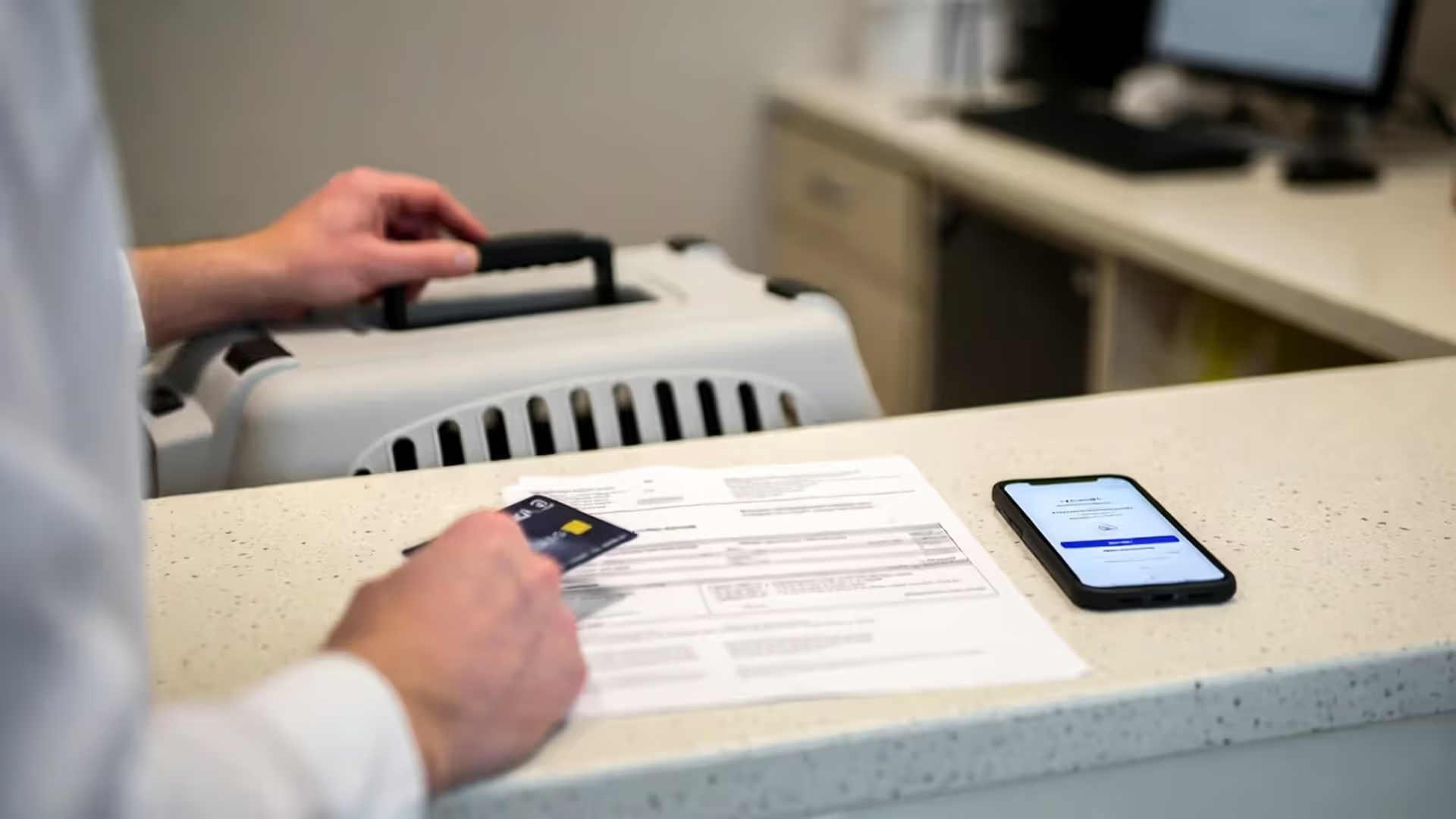
Here's what a pet insurance deductible actually means: It's the dollar amount you'll cover yourself before your insurance company starts reimbursing claims. The twist that catches people off guard? You pay your vet the full bill first, file paperwork later, then wait for your check. No card-swiping at the counter like your own doctor visits. You're fronting everything, then getting paid back based on your deductible and reimbursement rate.
Pick the wrong deductible level and you'll either waste money on premiums you didn't need to pay, or face surprise bills that wreck your budget right when your pet needs expensive care.

Author: Brandon Keller;
Source: lamadone.net
How Pet Insurance Deductibles Work in Practice
Think of your deductible as a threshold you cross by paying vet bills yourself. Once you've spent that much on covered treatments, your insurance kicks in and starts reimbursing based on your plan's percentage (usually 70%, 80%, or 90% of each bill).
The structure matters enormously. Annual deductibles work like your car insurance—you satisfy them once per policy year (starting from your enrollment date, not January 1st), then you're done until it resets 12 months later. Per-incident deductibles reset with every new diagnosis or injury your pet experiences.
Here's what that looks like with real numbers:
Your Beagle swallows a corn cob in February. Emergency surgery runs $2,800. You've got a $250 annual deductible and 80% reimbursement. You hand your credit card to the emergency vet for the full $2,800. Then you file your claim. Insurance subtracts your $250 deductible from the bill, leaving $2,550, then sends you 80% of that: $2,040. What you actually spent: $760.

Author: Brandon Keller;
Source: lamadone.net
Fast forward to April. Same dog gets an ear infection. Treatment costs $320. Since you already cleared your annual deductible back in February, insurance now reimburses 80% of the entire $320 bill—that's $256 back to you. You're only out $64 this time.
Switch that scenario to a per-incident deductible structure, though? That ear infection counts as a separate, unrelated condition. You'd pay another $250 deductible, meaning the full $320 comes from your wallet with zero reimbursement.
Another wrinkle: Some companies apply one deductible per household regardless of how many pets you insure. Others demand separate deductibles for each animal on your policy. For a three-dog household, that difference could mean paying $250 versus $750 in deductibles before seeing any insurance money.
Also worth knowing: Only covered expenses count toward your deductible. Pre-existing conditions, excluded treatments, and costs above your annual limit don't help you reach that threshold.
Common Deductible Amounts and What Insurers Offer
Walk through any major pet insurer's quote process and you'll typically see deductible options ranging from zero dollars up to $1,000, with some companies extending to $2,500 for owners chasing rock-bottom premiums.
Most companies structure their offerings in $50 or $100 increments. You'll frequently encounter $100, $250, $500, and $1,000 as the standard choices. Industry data shows $250 as the most popular selection—it hits a sweet spot where premiums stay reasonable without creating massive out-of-pocket shocks during emergencies.
| Provider | Available Deductible Amounts | Deductible Type | Typical Premium Difference (Low vs. High Deductible) |
| Nationwide | $250, $500, $1,000 | Resets annually | Premium drops roughly 35% going from $250 to $1,000 |
| Healthy Paws | $100, $250, $500 | Resets annually | Premium drops roughly 28% going from $100 to $500 |
| Trupanion | $0–$1,000 (any dollar amount) | One-time per condition | Premium drops roughly 40% going from $0 to $1,000 |
| Embrace | $200, $300, $500, $750, $1,000 | Resets annually | Premium drops roughly 32% going from $200 to $1,000 |
| Lemonade | $100, $250, $500 | Resets annually | Premium drops roughly 25% going from $100 to $500 |
| Spot | $100, $250, $500, $750, $1,000 | Resets annually | Premium drops roughly 30% going from $100 to $1,000 |
Trupanion operates differently from everyone else. Their per-condition model means you pay the deductible once for hip dysplasia, once for diabetes, once for cancer—but then never again for that specific diagnosis. If your Labrador develops hip problems requiring years of management, you clear the deductible on the first claim, then every future bill for that condition gets reimbursed at your percentage without another deductible applying. Ever.
Plan coverage also shapes deductible availability. Accident-only policies usually feature lower deductible options since they're covering fewer scenarios. Comprehensive accident-and-illness plans offer broader ranges to accommodate different financial strategies.
How Your Deductible Choice Affects Your Monthly Premium
Here's the fundamental relationship: raise your deductible, lower your premium. Always. The savings aren't proportional, though—the curve accelerates as you move higher.
Take a three-year-old Lab in Dallas with 80% reimbursement and $10,000 annual coverage. Here's how monthly costs shake out:
- $100 deductible: $68/month ($816 yearly)
- $250 deductible: $58/month ($696 yearly)
- $500 deductible: $48/month ($576 yearly)
- $1,000 deductible: $41/month ($492 yearly)

Author: Brandon Keller;
Source: lamadone.net
Bumping from $100 to $250 saves $120 over the year but exposes you to $150 more per claim. File one decent-sized claim annually and you're basically breaking even.
The math shifts considerably at higher levels. Jumping from $500 to $1,000 saves $84 per year while adding $500 to each claim's out-of-pocket cost. That trade-off only makes sense if you're banking on filing zero claims or you've got substantial savings to absorb the hit.
When a Higher Deductible Makes Financial Sense
Setting your deductible at $500 or $1,000 works if you maintain at least $2,000 in easily accessible emergency savings specifically for pet care. You're basically covering the small stuff yourself while protecting against five-figure catastrophes.
Young, healthy pets with clean genetic backgrounds rarely need major care in their first few years. A two-year-old mixed-breed dog with no health issues might cruise through 24-36 months without filing a single claim. Those premium savings really add up.
Multi-pet households face compounding deductible exposure. Insuring three cats with $250 deductibles each means potentially shelling out $750 in deductibles before reimbursements start. Raising each cat to $500 while stashing the monthly premium savings creates your own emergency cushion.
Higher deductibles suit people whose budgets can absorb a sudden $1,000 vet bill without disruption. If that amount wouldn't force you onto credit cards or into payment plans, the lifetime premium savings can exceed $2,000 over a pet's insurance coverage period.
When to Choose a Lower Deductible
Setting your deductible at $100 or $250 makes sense when your emergency fund sits below $1,000. If a surprise $500 expense would push you into debt, the moderately higher premium buys genuine financial security and predictable costs.
Breed-specific health risks justify lower deductibles. Bulldogs face breathing problems and overheating. German Shepherds develop hip and elbow dysplasia. Golden Retrievers battle cancer at heartbreaking rates. These conditions generate multiple claims over time, making lower deductibles pay for themselves.
Senior pets (generally 8+ for dogs, 10+ for cats) need increasing amounts of care. A 10-year-old dog might require arthritis injections, dental procedures, bloodwork panels, and medication refills—all potentially claimable events. Lower deductibles reduce the financial weight of managing age-related decline.
First-time pet owners consistently underestimate what veterinary care actually costs. Starting with a $100 or $250 deductible provides a gentler learning curve while maintaining solid coverage.
Calculating What You'd Pay: Deductible Scenarios by Claim Type
Numbers on a policy document don't mean much until you see them applied to actual veterinary situations.
Scenario 1: Emergency Foreign Body Surgery
Your Labrador eats a tennis ball. Surgery to remove it costs $3,500.
With $250 deductible and 80% reimbursement: - You pay the vet clinic: $3,500 upfront - Deductible gets subtracted: $250 - What's left for reimbursement: $3,250 - Insurance pays 80% of that: $2,600 - What you actually spent: $900
With $500 deductible and 80% reimbursement: - Deductible subtracted: $500 - What's left: $3,000 - Insurance pays 80%: $2,400 - What you actually spent: $1,100
That $250 deductible difference costs you $200 more on this claim. But it saves roughly $120 per year in premiums. If this is your only claim that year, the higher deductible actually cost you $80 net after accounting for the premium difference.
Scenario 2: Chronic Condition Management (Diabetes)
Your cat gets diagnosed with diabetes needing insulin, glucose monitoring, and regular checkups. First-year expenses total $2,400.
With $250 annual deductible and 90% reimbursement: - Deductible applied: $250 - Remaining amount: $2,150 - Insurance pays 90%: $1,935 - Your total cost: $465
With Trupanion's $500 per-condition deductible and 90% reimbursement: - First claim deductible: $500 - Remaining: $1,900 - Insurance pays 90%: $1,710 - Your first-year cost: $690 - Year two and beyond: Only your 10% copay, no deductible
The per-condition structure wins for chronic management. Year two with another $2,200 in diabetes expenses would cost you just $220 with Trupanion (only the 10% copay) versus $465 with an annual deductible that resets.
Scenario 3: Minor Illness (Gastroenteritis)
Your dog develops stomach upset requiring an exam, fluids, anti-nausea medication, and follow-up. Bill totals $380.
With $100 deductible and 70% reimbursement: - Deductible applied: $100 - Remaining: $280 - Insurance pays 70%: $196 - Your cost: $184
With $500 deductible and 70% reimbursement: - Bill falls completely under your deductible - Your cost: $380 (everything) - Amount credited toward deductible for the year: $380
This illustrates a key point: bills under your deductible provide zero immediate reimbursement. They do count toward meeting your deductible threshold, though.
Scenario 4: Multiple Incidents in One Year
Your active Australian Shepherd tears her CCL in March ($4,200 surgery) and fractures a tooth in October ($890 dental extraction).
With $250 annual deductible and 80% reimbursement: - March surgery cost: $1,090 (includes deductible plus your 20% copay) - Deductible now satisfied until next policy year - October dental cost: $178 (just your 20% copay on full amount) - Combined out-of-pocket: $1,268
With $250 per-incident deductible and 80% reimbursement: - March surgery cost: $1,090 - October dental (counts as new incident): $378 (fresh deductible plus 20% copay) - Combined out-of-pocket: $1,468
Annual deductibles save you $200 in this scenario, demonstrating their value for accident-prone pets or unlucky years.
5 Mistakes Pet Owners Make When Choosing a Deductible
Mistake 1: Selecting Based Purely on Monthly Premium
A $25 monthly difference feels significant when you're comparing quotes. But choosing your deductible intelligently requires calculating total yearly exposure—premiums plus anticipated claims.
That $300 annual premium savings evaporates instantly if you file one claim and you're carrying a deductible that's $500 higher than the alternative.
Calculate break-even points. If moving from a $250 to $500 deductible saves $180 yearly in premiums, you'd need 1.4 claim-free years to come out ahead. For a puppy's first policy year when everything goes in their mouth? You're probably filing at least one claim.
Mistake 2: Overlooking Annual vs. Per-Incident Structures
This distinction confuses people constantly. They see "$250 deductible" and assume all policies work identically.
A $250 per-incident deductible can drain your wallet faster than a $500 annual deductible if your pet develops multiple unrelated problems in one year.
Before you enroll, ask point-blank: "Does this deductible apply once per year or separately for each new condition?" Then verify the answer in your policy documents, because sales reps sometimes get this wrong.
Mistake 3: Ignoring Multiple-Pet Math
Insuring three dogs with $250 deductibles each creates potential exposure of $750 in deductibles before you see reimbursement money. Some companies offer multi-pet discounts, sure, but they still typically require individual deductibles per animal.
Calculate your household's total deductible exposure. Three pets at $500 each means $1,500 out-of-pocket before reimbursements begin. Does your emergency fund comfortably cover that scenario?
Mistake 4: Underestimating What Veterinary Care Actually Costs
Pet owners routinely choose high deductibles assuming they'll face maybe a few hundred dollars in vet bills annually. Then their dog needs emergency bloat surgery at $6,500. Or their cat develops kidney disease requiring $4,200 in first-year treatment.
Emergency veterinary care regularly exceeds $2,000. Specialty treatments—oncology, advanced imaging, orthopedic surgery—frequently surpass $5,000. Pick your deductible assuming you'll eventually face a significant claim, because actuarial data says you probably will.
Mistake 5: Setting It and Forgetting It
Your financial picture changes. Your pet ages. The $1,000 deductible that made perfect sense when you maintained $10,000 in savings might not work after you've depleted that fund replacing your HVAC system.
Similarly, your healthy two-year-old Pointer might justify a higher deductible initially. But at age eight with developing arthritis and a heart murmur? Switching to a lower deductible at renewal might save you money.
Most insurers let you adjust deductibles at your policy anniversary. Review this decision yearly, not just once at enrollment.
How to Pick the Right Deductible for Your Situation
Choosing your deductible wisely means evaluating five critical factors:
Emergency Fund Size
Match your deductible to your available savings. Practical guideline: Select a deductible no higher than half of your dedicated pet emergency fund. Got $1,000 set aside specifically for pet care? A $500 deductible leaves room for your copay portion.
Pet owners with under $500 in emergency savings should seriously consider $100-$250 deductibles despite the premium cost. The alternative often means debt or delaying care.

Author: Brandon Keller;
Source: lamadone.net
Pet's Age and Health Status
Puppies and kittens under one year experience lots of accidents (swallowed objects, broken bones from falls) but fewer chronic illnesses. A moderate deductible in the $250-$500 range balances costs against likely claims.
Adult pets from 1-7 years (dogs) or 1-10 years (cats) in good health can often handle $500-$1,000 deductibles, particularly mixed breeds without major genetic predispositions.
Senior pets benefit from $100-$250 deductibles as claim frequency climbs with age-related conditions like arthritis, dental disease, and organ dysfunction.
Number of Pets
Single-pet households enjoy maximum flexibility. Multi-pet homes must calculate cumulative deductible risk and total premium costs across all animals.
Insuring two dogs? Compare these scenarios: - Both at $250 deductible: Higher monthly premiums, maximum $500 deductible exposure - Both at $500 deductible: Lower monthly premiums, maximum $1,000 deductible exposure
The premium difference might reach $40-60 monthly—that's $480-720 annually. Banking that difference could fund your higher deductible costs while building a safety cushion.
Risk Tolerance
Conservative planners who value predictable budgets prefer lower deductibles. They'd rather spend $15 extra monthly than face a $500 surprise during an emergency.
Comfortable risk-takers who handle financial variability well often choose higher deductibles, treating insurance as catastrophic protection rather than coverage for every dollar.
Income Stability
Salaried employees with steady paychecks can more easily manage higher deductibles and the unpredictable timing of large vet bills. Freelancers, gig workers, or commission-based earners might prefer lower deductibles to avoid major expenses landing during slow income months.
Dr. Jennifer Coates, a veterinarian with over 20 years in practice who previously consulted for pet insurance companies, puts it this way:
I've watched clients select high deductibles to trim their premiums, then struggle to cover the out-of-pocket portion when their pet needs emergency care. The optimal deductible is one you can comfortably pay during a crisis without delaying treatment. Insurance should reduce financial stress, not create it.
— Dr. Jennifer Coates
Decision Checklist:
- Could you afford your chosen deductible amount within 24 hours without using credit cards?
- Have you calculated complete annual costs—premiums plus probable deductible expenses—for different options?
- Does your pet's breed carry specific health risks that increase claim probability?
- If you insure multiple pets, could you handle paying multiple deductibles simultaneously?
- Have you compared annual versus per-incident structures for your particular situation?
A "no" answer to any question signals you should reconsider your deductible selection.
FAQ: Pet Insurance Deductible Questions Answered
Making Your Deductible Work for You
Your deductible choice represents where monthly affordability meets emergency preparedness. The right selection has less to do with finding the "best" deductible and everything to do with matching coverage to your actual financial reality.
For most pet owners, $250 delivers the sweet spot—low enough to keep emergency costs manageable, high enough to maintain sensible premiums. Your circumstances might demand something different.
Run actual numbers for your specific situation. Calculate annual costs including both premiums and potential deductibles. Factor in your pet's age, breed predispositions, and health trajectory. Evaluate your emergency fund honestly.
Most critically, pick a deductible you could pay immediately when your pet needs care. Insurance that forces treatment delays because you can't cover the deductible has failed its core purpose: ensuring your pet receives necessary medical care regardless of cost.
Revisit this decision annually. Your pet ages. Your financial situation evolves. Coverage should adapt accordingly. The deductible that worked perfectly at enrollment might not serve you three years later.
Pet insurance exists to protect your pet's health and your financial stability simultaneously. Your deductible selection determines how effectively it accomplishes both goals.