Renewal day is a decision point.
Pet Insurance Policy Renewal How It Works and How to Decide

Content
Last Tuesday, you grabbed your mail and found that envelope from your pet insurance company. Premium's going up $18 monthly. Is that reasonable? Are you being price-gouged? Should you bail for a competitor?
Here's what most pet owners miss: your renewal date is the one time each year when you have real negotiating power. Not the fake kind where you call and threaten to leave. The actual kind—where you can walk away to a competitor without penalty, compare real quotes side-by-side, and make changes your insurer has to accept.
Unlike human health plans that lock you into enrollment windows, pet insurance lets you jump ship on your anniversary date. Most people just auto-pay without looking. That's leaving money on the table.
How Pet Insurance Renewals Actually Work
Your policy rolls over each year. Think of it like a book series, not a reboot—everything from the previous year carries forward into the next one.
Automatic vs. Manual Renewal Options
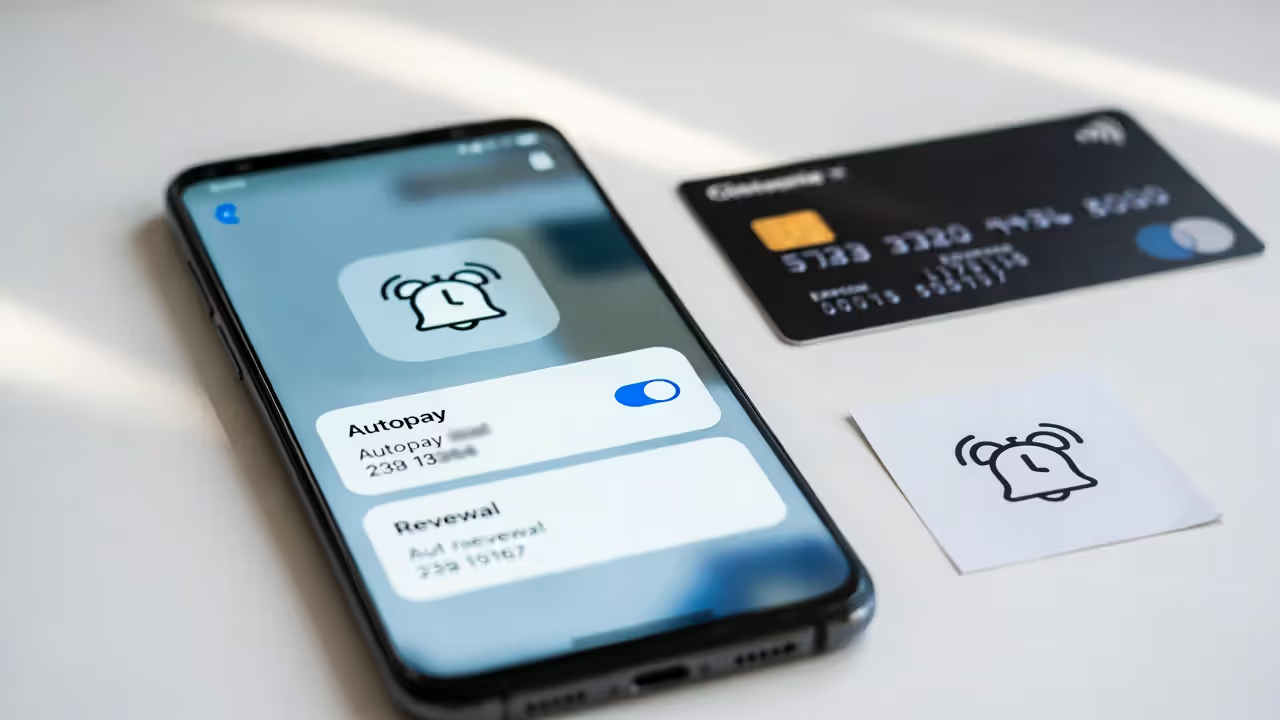
Probably 95% of pet insurers use automatic renewal. Your anniversary date hits, your card gets charged, and you're signed up for another year. The company mails a notice somewhere between 30-60 days beforehand listing your new rate and any coverage tweaks.
Manual renewal is the rare alternative. You have to say "yes, I want to continue" or your coverage ends. Sounds like more control, right? The downside: forget to renew, and you're starting from scratch as a new applicant. That bacterial skin infection from March? Pre-existing now. Your insurer won't touch it, and neither will anyone else.
Auto-renewal prevents that nightmare scenario. But here's the catch—you might not spot a $25 monthly increase until your credit card statement arrives.
Mark your calendar 45 days before your anniversary. That's your research window. Compare quotes, read the fine print, make your move.
Author: Brandon Keller;
Source: lamadone.net
Timeline and Notice Requirements
Your state probably requires 30 days' advance notice for renewals. Some mandate 45 or 60. The notice shows your new premium, explains changes, and tells you how to opt out.
This window is your switching opportunity. Find a better deal with Competitor B? You can start their policy on the exact day your current one ends—no overlap charges, no coverage gaps.
Starting a new policy early means double-paying. Your old policy runs through May 15th, but you're excited about the new one and start it May 1st. Congrats, you just paid two premiums for those 15 days.
Why Your Premium Increases at Renewal (And When It Doesn't)
Your renewal pricing will change. I can't tell you it won't. The question is how much and why.
Age drives the most predictable increases. A three-year-old Golden Retriever costs maybe $45 monthly to insure. That same dog at age nine? Probably $75-85. Not because she's sick—just because the actuarial tables show nine-year-old Goldens cost more to treat than three-year-olds. After age seven or eight, these jumps accelerate. Some breeds see 15-20% increases annually in their senior years.
Your claims history—and here's the surprising part—barely matters at major insurers. Filed $3,000 in claims this year? Your rate goes up the same amount as your neighbor who filed zero. Pet insurance doesn't work like car insurance. They're pricing you based on all Golden Retrievers in your zip code at your dog's age, not your individual experience.
That said, if Bella develops diabetes requiring ongoing treatment, you're effectively locked in. Switch companies, and that diabetes becomes pre-existing elsewhere. Your current insurer knows this, which brings up an uncomfortable truth about long-term pricing strategies.
Inflation adjustments affect everyone. Veterinary costs jumped 8% nationally last year. Your premium probably increased similarly. The insurer labels this "cost of care adjustment" or "veterinary inflation factor." You can't avoid it by having a healthy pet.
Regional pricing matters more than you'd guess. Moved from rural Montana to Seattle? Your renewal might show a 25% increase just from location. Urban vets charge more. States with higher liability costs drive premiums up. Even moving across town can shift you into a different rating zone.
Mid-year coverage changes show up in full at renewal. Added a wellness plan in October? Your renewal reflects 12 months of that add-on, not just the two months you had it.
The rare scenario where premiums stay flat: you've got a two-year-old mixed breed who had zero vet visits, nobody moved, and inflation was basically nonexistent. Happens once in a blue moon. Don't expect it to last.
Author: Brandon Keller;
Source: lamadone.net
Coverage Changes You Might See When Renewing
Price isn't the only thing that shifts at renewal. Your actual policy terms can change too—and these matter more than a $10 monthly increase.
Pre-existing conditions get locked in permanently. Fluffy had three ear infections this year? Ear problems are now pre-existing. Your renewal paperwork should list newly excluded conditions. Pull it out, cross-reference with your vet bills, make sure they got it right. Insurers occasionally classify conditions incorrectly.
Benefit limits might reset or might not—depends on your policy structure. Annual maximum of $10,000, and you used $3,000? You're back to the full $10,000 at renewal. But if you've got a lifetime cap of $50,000 and you've claimed $15,000 total, you're working with $35,000 remaining. That $15,000 doesn't magically reappear.
Policy terms sometimes get modified. Your insurer might extend waiting periods on specific conditions, redefine how they calculate "actual vet cost," or adjust their accident versus illness categories. These aren't personal attacks—they're usually industry-wide responses to claims patterns. Still annoying.
New exclusions occasionally appear in renewal documents. Maybe they're adding breed-specific limitations or dropping coverage for certain treatments across all policies. Rare, but it happens. If you see new exclusions, read them twice. This might be your signal to switch before those conditions arise and become pre-existing elsewhere.
Treat your insurance renewal like your pet's annual wellness exam—it's a checkpoint, not something you sleepwalk through. I see people who've stayed with the same insurer for five years paying 30-40% more than they would elsewhere for the exact same coverage. The pet insurance market got way more competitive in the last few years, and companies don't reward loyalty like other industries do. One hour of comparison shopping each year is probably the highest-ROI activity you can do as a pet owner.
— Dr. Sarah Chen
Your Renewal Checklist: 6 Steps Before You Auto-Renew
Give yourself one hour annually. That's all this takes. You might save $400 or catch a coverage problem before it matters.
Step 1: Calculate what you actually got back. Pull your claims history. You paid $720 in premiums this year and got $280 reimbursed. You're $440 in the red. Does that mean insurance is a scam? Not necessarily. You're buying protection against the $8,000 emergency surgery, not trying to profit on routine visits. The real question: could you write a $8,000 check tomorrow without sweating?
Step 2: Get three competitor quotes minimum. Use your exact current specs—same $500 deductible, same 80% reimbursement, same $10,000 annual max. Otherwise you're comparing apples to hand grenades. I've seen pet owners paying 30% more than they should for identical coverage. Request quotes 45 days out so you have decision time.
Step 3: Match coverage to your pet's current life stage. That puppy policy made sense at age one. Your dog's now seven and entering the expensive years. Maybe you need a higher annual limit. Or maybe she's been healthy forever, you've got $15,000 in savings, and you should raise your deductible to $750 and pocket the premium difference.
Step 4: Check for group discounts you didn't know about. Your employer might offer pet insurance through benefits now—some companies started adding it in 2023-2024. Professional associations, alumni groups, Costco membership, AAA—all sometimes have 10-15% discount partnerships. These often beat retail rates.
Step 5: Update your payment method and contact info. Expired credit card equals lapsed policy equals every condition your pet has becoming pre-existing if you reapply. Update details two weeks before renewal minimum. Not the day before when you remember at 11 PM.
Step 6: Document your pet's current health status. Photograph your renewal documents showing no pre-existing conditions for specific issues. Switching insurers later and they claim your dog's limp from October was "obviously developing" back in March? Your documentation proves otherwise. Insurance companies have been known to dig through records creatively.

Author: Brandon Keller;
Source: lamadone.net
When Switching Beats Renewing Your Current Policy
Pet insurance rewards disloyalty. No relationship bonus for staying five years. No customer appreciation discount. Competitors want your business and will underprice your current insurer to get it.
But switching has friction costs. You need to know when it's worth it.
Major price increases without obvious reasons deserve investigation. Premium jumped 25%, but your dog didn't age into a new bracket and you filed one $200 claim? Get competing quotes. Some insurers raise rates 15-20% hoping you won't notice. That's $360-480 annually you could save by switching.
Terrible claims service is a valid exit reason. Your insurer denies legitimate claims repeatedly, takes four months to reimburse, or their customer service makes you want to throw your phone? The stress costs something. But verify the problem's actually them. Read your policy first—a lot of "denied claims" turn out to be "things that were never covered."
Better coverage elsewhere becomes critical as pets age. Found a policy with a $15,000 annual max instead of your current $10,000, better hereditary condition coverage, and included wellness for similar money? That's worth switching—assuming your pet doesn't have existing conditions that would become pre-existing.
Waiting periods are your main switching obstacle. Most new policies impose two-week accident waiting periods and 30-day illness waiting periods. Orthopedic issues often have six-to-nine-month waiting periods. Get sick during that window? You're paying premiums and getting nothing.
The switching sweet spot: your pet's under five, healthy with no chronic conditions, and you found coverage that's significantly better or 20%+ cheaper. Worst time to switch: your pet's managing diabetes or kidney disease that your current policy covers but would be excluded as pre-existing elsewhere.
Pet insurance renewal isn’t just a billing event—it’s the moment when pet owners should reassess risk, coverage, and value. A yearly review often reveals better protection or significant savings.
— Dr. Melissa Hartwell, Veterinary Health Policy Analyst
Common Renewal Mistakes Pet Owners Make
Treating the renewal notice like junk mail. About 40% of pet owners—according to industry surveys—admit they don't read renewal documents carefully. Then they're shocked when a claim gets denied for an exclusion that was listed right there on page two. It's not junk mail. Read it.
Thinking claims don't matter because premiums went up anyway. Your claims history might not affect your personal rate, but it tells you something important about your pet's health trajectory. A dog with $4,000 in annual claims probably needs that insurance more than one with zero claims—even though both face similar premium increases. Pay attention to patterns.
Switching without checking the pre-existing condition trap. Your dog seems healthy. But there's a vet note from eight months ago about "possible mild allergies" that didn't amount to anything. Switch insurers, and that note might disqualify all allergy coverage under your new policy. Request your pet's complete medical records before switching. Read them. One throwaway line can cost you thousands.
Canceling before the replacement starts. Frustration with a rate increase makes you cancel immediately. Then your cat gets a UTI during the coverage gap, you pay $800 out of pocket, and when you reapply somewhere, that UTI history becomes pre-existing. Overlap policies by one day—don't create gaps.
Never asking about discounts. Pet insurers won't tell you about every available discount. You have to ask. Multi-pet discounts, pay-annually discounts, military or veteran discounts, loyalty credits—some of these knock 5-10% off your premium. Make the phone call.
Renewal Price Increase Factors Comparison
| Factor | Typical Annual Impact | Can You Control It? | Notes |
| Pet's age | 5-20% depending on age bracket | No | Increases speed up after age 7-8; larger breeds enter "senior pricing" sooner |
| Claims filed | 0% at most major insurers | Partially | Filing claims doesn't spike your individual rate, but chronic conditions lock you in with your current provider |
| Inflation/vet cost increases | 4-8% annually | No | Industry-wide increases applied to all policyholders whether you filed claims or not |
| Zip code changes | -10% to +15% | Yes | Relocating to lower-cost regions can drop premiums; check rates before moving if possible |
| Coverage upgrades | Varies widely | Yes | Adding wellness riders, dropping deductibles, or raising limits increases premiums proportionally |
Frequently Asked Questions About Pet Insurance Renewals
Your policy renewal is a decision point. Not a formality. The coverage that worked when your Labrador was two might be wrong now that she's seven. The insurer offering the best rate in 2021 might have been leapfrogged by competitors.
Start reviewing six weeks before your anniversary date. That gives you time to collect comparison quotes, review medical records, and decide without rushing. Staying with your current insurer? At least you know you made an active choice. Switching? You have time to coordinate the transition cleanly.
The goal isn't finding the cheapest premium—it's finding the best value for your specific pet. A policy costing $20 more monthly but covering hereditary conditions your breed is prone to might save you $4,000 down the road. Conversely, paying for coverage you'll realistically never use wastes money that could go into a dedicated emergency fund earning interest.
Keep notes about your decision. Why you renewed or switched, what quotes you collected, which factors mattered most. Next year's renewal becomes easier when you can reference this year's research and see how your thinking evolved.
The renewal process doesn't need to be complicated. Review costs, compare options, verify coverage matches current needs, make a deliberate choice. Follow that pattern consistently, and you protect both your pet and your bank account.